A Video-Conferencing Platform Whose Server Never Holds the Keys
Case StudyLiveKitZero TrustSecuritySome organizations need more than encrypted transport from a video platform — they need the platform operator itself to have no access to what's said or shared. Building that in, properly, meant more than picking an encryption library.
Context
This client builds a video-conferencing and unified-communications platform for organizations that can't use a standard global provider, hosted and operated within the EU under its data-protection and privacy rules. Healthcare providers, judicial systems, and other regulated enterprises are typical examples: telemedicine and radiology consultations, judicial interrogations with waiting-room and remote-participant controls, internal workshops and lectures. What these have in common isn't the sector, it's the trust model — the platform operator itself must not be able to see meeting content, not just promise that the network in between can't.
The project
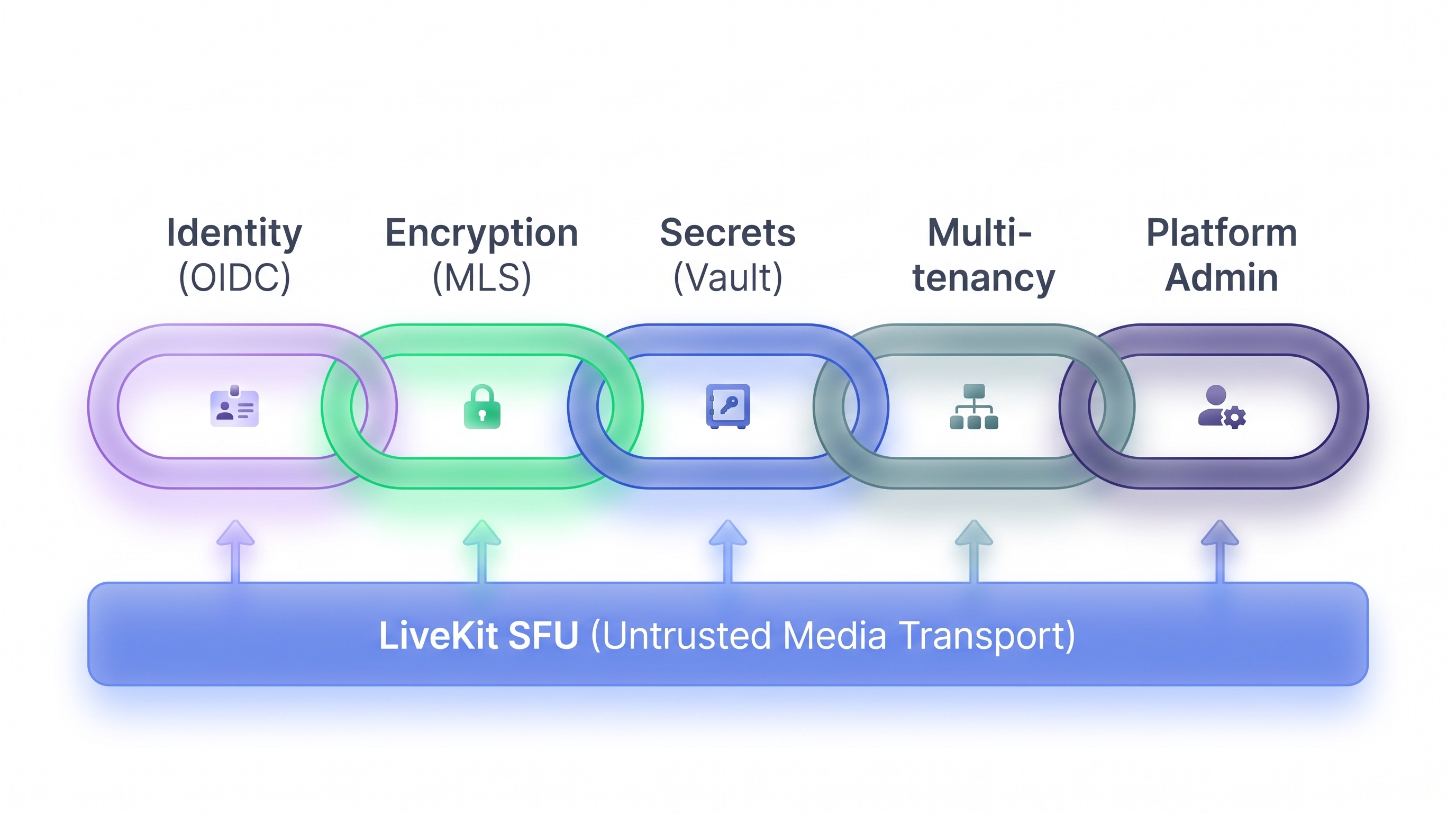
The base here is LiveKit's SFU — real-time media at scale is already a solved problem there. What this project actually needed was everything built on top of it: a stack of security layers, each answering a different question, plus the tenant isolation and platform-level administration a single shared deployment needs to serve multiple separate organizations safely.
Encryption
The video layer runs on LiveKit's SFU, scaling a single room to up to 100 participants with adaptive bitrate. On top of that sits a genuine end-to-end encryption layer using MLS (Messaging Layer Security) for key distribution and for encrypted chat and file sharing, with the server itself reduced to an untrusted transport — it never holds a key capable of decrypting anything passing through it.
MLS wasn't part of the platform's original design, and adding it reshaped two things the rest of the product had to live with. Guest access — joining through an unauthenticated link — breaks the security model outright, so an encrypted session requires every participant to already be an authenticated user. And because key management happens entirely inside each participant's own browser, with the server never touching a key, a SIP endpoint has no way to take part in that exchange — encryption and SIP integration end up mutually exclusive in the same meeting, not something reconcilable after the fact.
Recordings get the same treatment from a different angle: each one is encrypted on the client with a passphrase only its owner holds, and the platform itself has no way to decrypt one on its own.
Identity
Confirming who's actually joining an encrypted session runs through its own identity-verification flow, kept deliberately separate from the platform's regular login. That separation limits what a compromise of either side could actually reach, and keeps the encrypted-session flow doing exactly one job: confirming who someone is, nothing more.
Secrets
None of the layers above mean much if the credentials behind them are easy to leak or slow to rotate. Every credential in the platform — API keys, internal certificates, database access, the keys behind the media layer itself — is centralized and rotated on a schedule, including for services that don't normally support picking up new credentials without a restart. That rotation infrastructure turned out to be general enough to reuse well beyond this one platform.
Multi-tenancy
Each client organization on the platform is isolated from every other one: its own branding and disclaimers, its own user provisioning, and its own SSO connection to Active Directory or Microsoft Entra, kept separate per tenant rather than shared across the deployment.
Platform administration
Running all of that as one shared deployment still needs an operator layer above any single tenant — onboarding new client organizations, managing settings that apply platform-wide, and reviewing meeting and participant history across tenants, from a super-admin surface a regular tenant admin never sees.
Legacy integration
Bringing older video-conferencing hardware (SIP, H.323) into the same sessions is its own specialty, and not a new one for us — we'd already built this once before for OpenVidu, on Kurento. LiveKit doesn't ship an equivalent, so this platform's SIP/H.323 integration had to be built from the ground up: a dedicated gateway layer, kept isolated from the rest of the platform rather than exposed directly, bridging content sharing and remote camera control across to whatever hardware supports them. That gateway is also exactly where the SIP/encryption boundary above comes from — a different protocol world, decoupled from the rest on purpose. Real depth in both SIP and WebRTC at once is rare; having already solved this once, on a completely different media server, is what made solving it again a known problem rather than a research project.
Our role
- Designing and building the LiveKit-based, MLS-encrypted video layer, including the guest-access and SIP-incompatibility constraints that came with it.
- Building the dedicated identity-verification flow for encrypted sessions, isolated from the platform's own login.
- Designing and building the centralized secrets infrastructure and its zero-downtime rotation across the platform.
- Building the client-side encrypted recording pipeline.
- Designing the multi-tenant isolation model, including per-tenant branding and SSO.
- Building the super-admin layer for platform-wide administration, separate from any tenant's own admin surface.
- Building LiveKit's SIP/H.323 gateway layer from scratch, extending the same SIP/WebRTC expertise already proven on OpenVidu to a different media server, including content sharing and remote camera control.
Technologies
- LiveKit, for the underlying SFU and its native end-to-end encryption support.
- MLS (RFC 9420), for E2EE key distribution and encrypted chat/file sharing.
- OIDC, for identity verification on encrypted sessions, and for per-tenant SSO to Active Directory / Microsoft Entra.
- HashiCorp Vault, for centralized secrets, certificate, and database-credential management.
- A custom gateway layer, for SIP/H.323 integration with the rest of the platform.
Conclusion and lessons learnt
Real end-to-end encryption doesn't just add a feature, it changes what the rest of the platform is allowed to promise at the same time: no guest access, no SIP in the same session, because both would quietly undermine the guarantee E2EE exists to make. That's a product decision as much as a technical one, and it only became visible once MLS was actually being integrated rather than scoped on paper. The secrets and rotation infrastructure turned out to be worth more than this one platform, too; it was built generally enough to carry over to other projects directly, which is exactly what happened. We go deeper into the Zero Trust and data-protection tension behind this kind of platform in a companion post.